

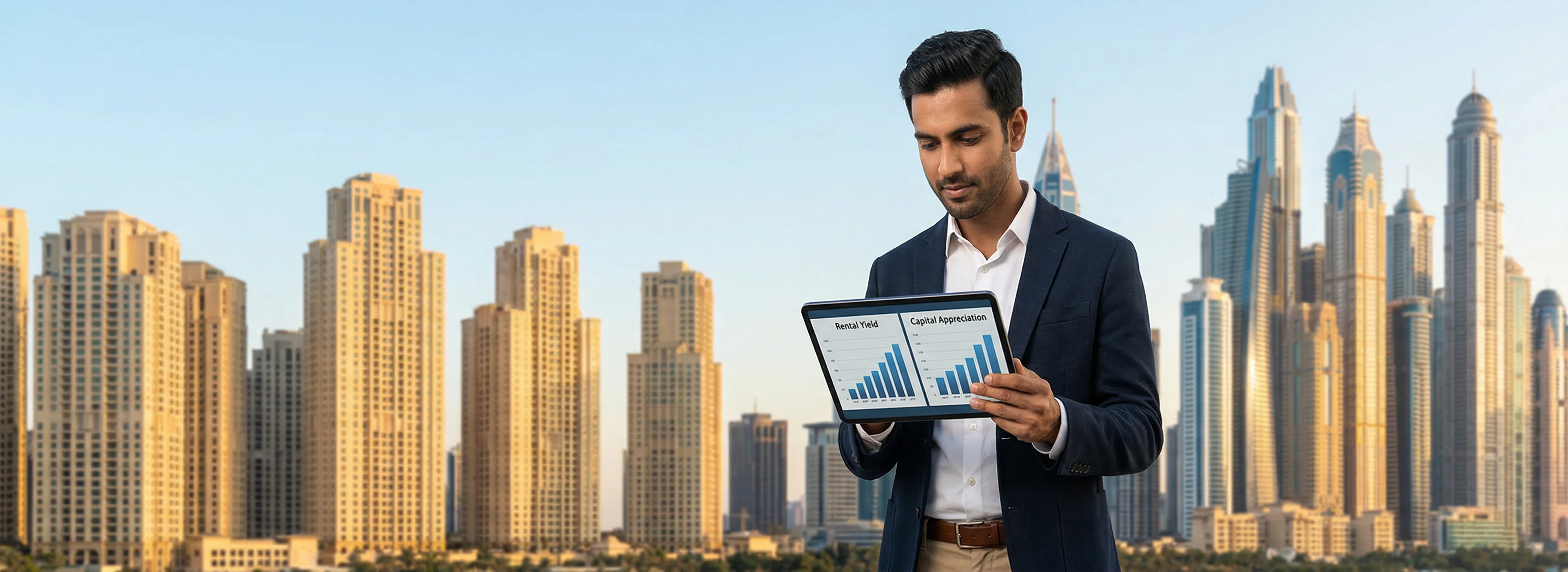
Rental Yield vs Capital Appreciation Dubai 2026
A Data-Backed Framework for Investors Choosing Between Income and Long-Term Growth
Every serious Dubai investor reaches the same fork in the road. Do you buy for monthly income or hold for long-term growth? The question sounds simple. The real answer depends on your cash flow requirements, your investment horizon, and which communities you are actually looking at. In 2026, with gross rental yields averaging 6.8% citywide and capital growth still running in double digits in select zones, getting this decision right matters more than ever. This guide gives you the data and a clear framework to make it with confidence, not guesswork.
What Rental Yield and Capital Appreciation Actually Mean
Rental yield is the annual rent you collect expressed as a percentage of what you paid. A unit bought at AED 800,000 that rents for AED 60,000 a year delivers a 7.5% gross yield. Straightforward. Capital appreciation is the increase in your property's market value over time. A unit bought at AED 1.5 million that is now worth AED 2.1 million has appreciated 40%. That gain is realised when you sell.
The two strategies are not mutually exclusive, but they pull in different directions. High-yield properties tend to sit in affordable communities where entry prices are low relative to rental demand. High-appreciation properties tend to cluster in premium locations where land scarcity, brand value, and the calibre of the buyer base drive long-term price gains. Confusing the two leads to portfolio decisions that disappoint on both fronts.
Why This Decision Carries Extra Weight in Dubai
Dubai's tax-free environment amplifies both strategies. There is no income tax on rental earnings. No capital gains tax on resale profit. The full yield lands in your account. This is why Dubai's 6.8% citywide gross average genuinely competes with the 2–4% net yields common in London, Singapore, or Paris, according to Q3 2025 market data published by Property Monitor.
But the split between high-yield and high-appreciation zones in Dubai is sharper than in most global cities. A studio in International City can deliver a 9% gross yield. The same capital deployed in a one-bedroom in Downtown Dubai may yield 4.5%. Neither is wrong. They are solving different financial problems, and the data for 2026 makes those differences clearer than ever.
The 2026 Yield and Appreciation Data by Zone
Based on Bayut's H1 2025 research and Property Monitor data, the breakdown across key areas looks like this:
| Area | Gross Yield | Appreciation Profile | Best For |
|---|---|---|---|
| International City | 8–9% | Moderate | Pure income investors, cash flow-first strategy |
| JVC | 7.3–7.8% | Moderate–Good | Balanced income + steady capital growth |
| Discovery Gardens | 7–8% | Moderate | Affordable entry, stable tenant base |
| Al Furjan | 7.5–8.5% | Moderate | Yield-focused with infrastructure upside |
| Business Bay | 5–6.5% | Good | Mixed strategy, strong rental demand + liquidity |
| Dubai Marina | 4–6.5% | Strong | Capital appreciation + premium resale market |
| Downtown Dubai | 4–5% | Strong | Long-term wealth building, institutional-grade asset |
International City, JVC, and Discovery Gardens consistently top the gross yield rankings because their purchase prices remain relatively low while tenant demand from working professionals and mid-income families stays deep and stable. Dubai Marina and Downtown deliver lower headline yields but have recorded some of the strongest capital value gains over the past three years as the city absorbed record transaction volumes.
How to Choose the Right Strategy for Your Situation
The honest answer is that the right strategy depends on three variables: your cash flow position today, your investment horizon, and whether you can stomach capital that is locked up for five or more years.
Choose yield if: you need your property to generate regular income from day one. A gross yield of 7–8% in JVC or Al Furjan on an AED 700,000 apartment translates to roughly AED 49,000–56,000 annually before expenses. That is real cash flow you can plan around.
Choose appreciation if: you have a 7–10 year horizon, you do not need the income today, and you want your capital to compound through price growth. Downtown Dubai and Dubai Marina have historically held value through market cycles and attract the kind of international buyers who sustain resale liquidity.
Consider splitting: experienced investors often structure their Dubai portfolio with roughly 60% in buy-to-let assets for stable income and 40% in off-plan or premium properties for capital growth. The income from the yield properties funds holding costs while the appreciation assets compound quietly in the background.
The Mistake Most Investors Make — And the Honest Caveat
The most common error is chasing the highest headline yield without looking at the area's supply trajectory. A 9% gross yield in a corridor where twelve new towers are expected to hand over in the next 18 months is not the same as a 9% yield in an established community with constrained new supply. Rental rates compress when vacancy rises. The percentage looks attractive on a spreadsheet until it does not.
Equally, buying a premium property purely for appreciation is a long game that requires genuine patience. Bayut's 2025 market research shows that affordable apartment areas in International City and Discovery Gardens delivered yields of 9–10%, while luxury areas posted capital gains of 4–16% in the same period. Neither category dominated both metrics simultaneously.
The closing principle that should anchor any decision: a 9% ROI in a declining area is worse than a 6% ROI in a booming infrastructure zone. In 2026, the sharpest investors are not picking one strategy over the other. They are building portfolios that balance yield for safety with appreciation for wealth. Both have a place. The ratio is what requires thinking through.
Related Questions
International City, Discovery Gardens, Al Furjan, and JVC consistently lead on gross rental yield, with apartments delivering 7–9%. These areas combine affordable entry prices with deep, stable tenant demand from working professionals and mid-income families.
Rarely in the same unit. Communities that top yield rankings typically see moderate capital appreciation because purchase prices are already modest. Premium areas like Downtown Dubai and Dubai Marina offer stronger appreciation but lower gross yields. Business Bay occupies a middle ground, offering 5–6.5% yield with good appreciation prospects.
A 9% gross yield is achievable in areas like International City and is backed by real transaction data. The key question is what it looks like after expenses: service charges, management fees, maintenance, and potential vacancy. Net yields are typically 1.5–2% lower than gross. Also check the area's future supply pipeline before committing. High gross yield in an oversupplied corridor can compress quickly.
NRI investors with a long-term UAE connection often benefit from a split approach: one income-generating property in a high-yield community provides rupee-equivalent cash flow, while a premium property held for 7–10 years builds capital. The Golden Visa threshold of AED 2 million also makes premium appreciation plays structurally attractive for residency planning.
It means roughly 60% of your Dubai property allocation sits in buy-to-let assets, typically mid-market apartments in yield-first zones, that generate monthly rental income. The remaining 40% is deployed in off-plan or premium ready properties where the thesis is capital growth over a 5–10 year horizon. The income from the yield assets covers holding costs, keeping the appreciation plays from becoming a cash drain.