

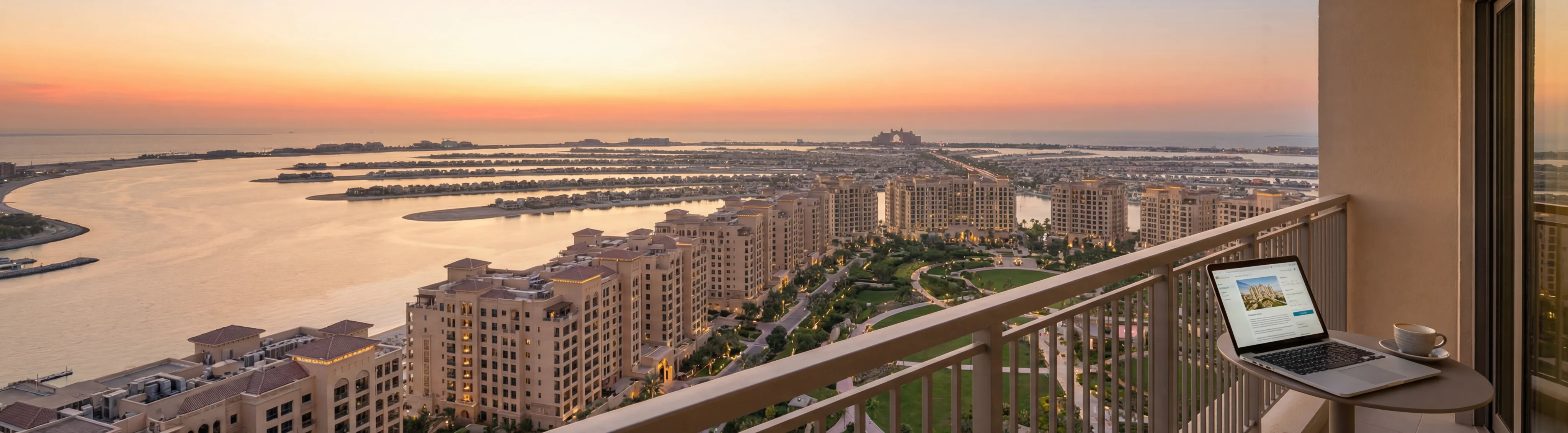
Palm Jumeirah Service Fees Capped | 3-Year Fixed Ruling
Palm Jumeirah service charges 2026- cost & maintenance fees
A 1,200-square-foot apartment on the Palm Jumeirah trunk can carry annual service charges north of AED 25 per square foot. Multiply that across a five-unit portfolio and the number stops being a line item. It becomes a strategy question. That is precisely why the Dubai Land Department's December 2025 decision to approve three-year fixed service fees for the Palm Jumeirah Master community caught the attention of serious investors. For the first time in the emirate's history, owners on the Palm can now budget their community maintenance costs across a locked three-year window rather than facing annual recalculations. This article breaks down who benefits, how net yields shift, and what the ruling signals for the wider Dubai market.
What the Three-Year Fixed Fee Ruling Actually Says
In December 2025, the Dubai Land Department confirmed that it had worked with Dubai Holding Community Management to approve a three-year fixed service fee budget for the Palm Jumeirah Master community. The approval was processed through the Mollak system, the digital platform RERA uses to regulate service charge budgets across all jointly owned properties in Dubai.
Eng. Abdullah Ahmed Al Shehhi, CEO of the Real Estate Regulatory Agency at DLD, confirmed that all community management companies across Dubai are eligible to adopt this mechanism. However, it remains optional. Management entities that prefer to continue with the traditional one-year budgeting cycle can do so without penalty.
The practical effect is straightforward. Under the new model, a JOP management company submits a three-year operational budget to RERA via Mollak. Once approved, that budget sets the service charge rate for the full period. The management company can then enter into multi-year contracts with service providers, locking in pricing for security, landscaping, cleaning, and facility maintenance.
Palm Jumeirah is the first community to have its budget approved under this framework. The ruling was announced during a collaborative workshop between DLD and Dubai Holding Community Management, as reported by Gulf News, Khaleej Times, and Arabian Business in December 2025.
Why Service Charges Matter So Much on Palm Jumeirah
Service charges are not a rounding error on the Palm. According to the RERA Service Charge Index and data compiled by Driven Properties, apartments in Palm Jumeirah towers typically pay around AED 25 per square foot annually. Some luxury towers push well beyond that figure. Driven Properties notes that premium locations like Downtown Dubai and Palm Jumeirah can exceed AED 60 per square foot in the most amenity-heavy buildings.
For context, a two-bedroom apartment of 1,500 square feet at AED 25 per square foot generates an annual service charge bill of AED 37,500. A penthouse of 4,000 square feet at AED 30 per square foot faces AED 120,000 in annual charges before any other holding cost is considered.
These figures matter because Palm Jumeirah is not a high-yield market. Gross rental yields on the island typically range between 3.5 percent and 5.5 percent for long-term tenancies, according to data from Cavendish Maxwell and Knight Frank cited by multiple market analysts. Net yields, after deducting service charges, maintenance, and vacancy, run 1.5 to 2 percentage points lower. In a market where gross yields already compress due to premium purchase prices, every dirham of service charge directly erodes investor returns.
What drives these numbers so high? Palm Jumeirah is not a standard residential community. The island requires continuous maintenance of its breakwater, shoreline infrastructure, monorail system, and trunk road network. On top of that, individual tower communities fund pools, gyms, concierge desks, parking facilities, and district cooling systems. Each of those line items flows into the per-square-foot service charge.
NOVVI Properties notes that in luxury towers, particularly in Downtown Dubai and DIFC, service charges can consume up to 30 percent of annual rental income. The same dynamic applies to high-amenity buildings on Palm Jumeirah. When that expense is unpredictable from year to year, cash flow planning becomes guesswork rather than strategy. For investors comparing the Palm against communities like Dubai Hills Estate or Emaar Beachfront, service charge transparency is often the deciding factor.
How Fixed Fees Change the Net Yield Calculation
The investor case for three-year fixed service fees rests on one word: predictability. Before this ruling, every Palm Jumeirah owner faced an annual reset. RERA would audit and approve the management company's budget each year through Mollak, and the resulting per-square-foot rate could shift based on utility costs, inflation, contractor pricing, or facility upgrades.
Under the new mechanism, that annual uncertainty disappears for the approved period. For those buying property in Dubai, this adds a new layer of financial clarity. An investor purchasing a Palm Jumeirah apartment today can factor in a locked service charge for three consecutive years when modelling net returns. The table below illustrates how this predictability affects a typical holding scenario.
| Metric | Annual Model | 3-Year Fixed Model |
|---|---|---|
| Service charge (AED/sq ft) | Variable each year | Locked for 3 years |
| Net yield variance | Fluctuates annually | Stable across period |
| Budget confidence | 12-month horizon | 36-month horizon |
| Contractor pricing | Annual renegotiation | Multi-year contracts |
| Cash flow forecasting | Estimated only | Precise for 3 years |
This stability is especially valuable for investors who hold multiple units or who finance purchases with mortgages. When service charges can swing by 5 to 10 percent year on year, the margin between a profitable unit and a break-even one narrows quickly. A three-year lock removes that variable from the equation.
Consider a practical example. An investor holding a 1,500-square-foot apartment with a gross yield of 5.5 percent and annual service charges of AED 37,500 has a net yield that shifts every year as charges are recalculated. Under the fixed model, that AED 37,500 figure holds firm. If rents increase during the period while costs stay flat, net yield improves without any active intervention from the owner.
It also benefits investors who rely on property management companies to handle tenancies. With fixed costs on the community side, a property manager can quote tighter net yield projections to prospective buyers, which in turn supports secondary market pricing and resale confidence.
Who Benefits Most from Predictable Service Costs
The ruling does not apply equally to every owner on the Palm. The fixed fee mechanism covers the Palm Jumeirah Master community, which means the shared infrastructure and common areas managed by Dubai Holding Community Management. Individual tower management fees, which cover internal building amenities like gyms, pools, and concierge services, remain subject to their own annual budgets unless those management companies also adopt the three-year model through Mollak.
That said, several investor profiles stand to gain the most. Portfolio holders with three or more units on the Palm can now aggregate their service charge exposure into a single, predictable figure across a meaningful investment horizon. NRI and international investors who manage Dubai assets remotely gain clarity without needing to monitor annual budget shifts. Mortgage buyers benefit from improved debt service coverage calculations when presenting refinancing cases to UAE banks.
For villa owners, the impact is particularly welcome. Palm Jumeirah villa communities carry service charges that include beach maintenance, frond landscaping, security patrols, and trunk road upkeep. Arabian Sunrise Properties reports villa service charges on the Palm at AED 10 to AED 15 per square foot. On a Signature Villa with 8,000 square feet of plot, that translates to AED 80,000 to AED 120,000 annually. Locking that figure for three years provides genuine financial planning value.
What This Signals for Other Dubai Master Communities
The DLD has confirmed that every community management company in Dubai is eligible to apply for the three-year budgeting mechanism. Palm Jumeirah is the pilot, but the framework is designed for emirate-wide adoption. Eng. Al Shehhi stated clearly that this step forms part of RERA's ongoing efforts to strengthen transparency and improve the efficiency of community management across the emirate.
For investors watching Dubai Hills Estate, Dubai Creek Harbour, Emaar Beachfront, or Bluewaters, this ruling sets a precedent. If the Palm Jumeirah pilot demonstrates operational efficiency and owner satisfaction, expect other master developers to follow. Emaar and Nakheel communities, which already operate mature Mollak-integrated budgets, are natural candidates for early adoption.
The broader signal is one of market maturity. Dubai's real estate regulatory framework continues to evolve toward institutional-grade governance. Fixed-period service charge budgets bring Dubai closer to the transparency standards that sovereign wealth funds and family offices expect when deploying capital into residential real estate. For a market that recorded over 215,000 transactions in 2025, according to DLD data, this kind of regulatory refinement supports long-term investor confidence.
There is also a practical benefit for Mollak itself. The platform's digital data integration and verification processes have been strengthened as part of this initiative. Streamlined documentation reduces the administrative burden on management companies and gives owners faster access to audited budget breakdowns. As more communities adopt the three-year model, the system's dataset grows richer, giving RERA better benchmarking tools across the emirate.
Related Questions
Not exactly. The three-year fixed fee mechanism applies to the Palm Jumeirah Master community budget managed by Dubai Holding Community Management. Individual tower management companies set their own building-level charges separately. Those fees remain on annual budgets unless the tower's management company also opts into the three-year Mollak model.
Yes. The fixed fee locks the rate for the approved three-year window only. When that period expires, the management company submits a new budget for RERA approval. The new rate could be higher or lower depending on operational costs, inflation, and facility requirements at that time.
The mechanism is open to all community management companies across Dubai. Palm Jumeirah was the first project approved under the framework. Other communities can apply through Mollak, though adoption depends on each management company's decision to pursue multi-year budgeting.
Fixed fees give you a precise holding cost for three years, which sharpens your net yield calculation. Instead of estimating annual service charges, you can subtract the exact locked figure from your rental income. This is especially useful for investors comparing Palm Jumeirah yields against other Dubai communities where charges remain variable. When building a five-year hold model, the first three years now carry verified numbers rather than projections.