

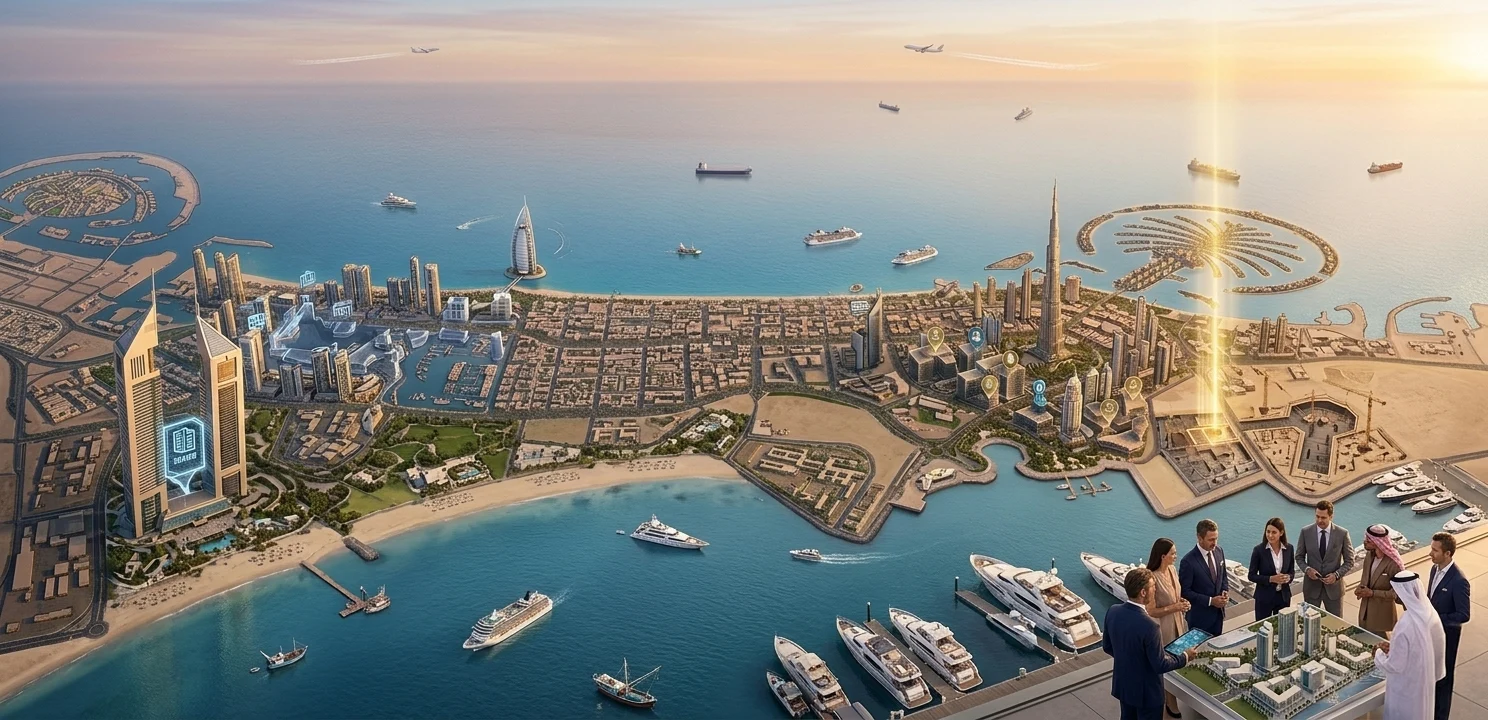
Dubai Property Market 2026 America-Iran War: Hidden Buying Opportunities
The headlines have been alarming. Iranian missiles and drones struck UAE infrastructure in late February 2026, following US and Israeli military action against Iran. Dubai International Airport temporarily restricted access. The DFM Real Estate Index fell 20 percent in five trading sessions, wiping out every gain made in 2026 up to that point. Inquiry levels at major brokerages dropped by nearly half almost overnight.
This article addresses that honestly. No hype, no panic just what the numbers say, what history shows, and what anyone considering a purchase in Dubai right now needs to think through carefully.
What Actually Happened to the Dubai Property Market
To understand the opportunity, you first need to understand what actually shifted and what did not.
- What shifted: Sentiment, transaction volumes, and stock prices. The DFM Real Estate Index erased all of 2026's gains in under a week. Inquiry levels fell roughly 45 percent. Developer equities including Emaar dropped around 5 percent on market reopening. Bond markets effectively closed for new developer issuance, raising financing costs across the sector.
- What did not shift: The underlying price per square foot in the physical real estate market. No mass sell-off. No distressed listings flooding the market. No developer cutting prices on new launches.
This distinction matters because it tells you what kind of market event this actually is. It is a sentiment correction, not a structural collapse. The two things look similar from the outside but play out very differently over the following 12 to 24 months.
The Numbers That Entered This Crisis
Residential prices had risen approximately 60 to 75 percent since 2022. Rental yields across prime Dubai sat between 6 and 9 percent annually among the highest of any major global city. Over 9,800 millionaires relocated to Dubai in 2025, bringing an estimated USD 63 billion in wealth with them. These are not the conditions you would expect before a structural collapse. They are the conditions of a well-capitalised market absorbing an external shock.
The Hidden Opportunity: What Conflict-Driven Pauses Actually Create
Here is the part that does not often appear in mainstream coverage. When international buyers pause even briefly sellers who need liquidity do not pause with them. They adjust price. Since late February 2026, a cluster of distress deals has emerged across prime Dubai, including Palm Jumeirah and Dubai Marina. These are not distressed because the buildings are problematic or the locations have lost their value. They are distressed because the sellers facing payment plan obligations, relocation timelines, or financial restructuring cannot afford to wait for sentiment to normalise.
What History Actually Shows About Dubai During Regional Conflicts
Dubai has been through this before. Not once, but several times. During the 2008 to 2009 global financial crisis, Dubai saw sharp price declines. Buyers who acquired at the bottom in 2009 to 2010 were sitting on 200 percent capital gains by 2014. The oil-driven correction between 2014 and 2016 brought prices down 25 to 35 percent. By 2022, prime area properties had recovered 80 percent and beyond. COVID-19 in 2020 triggered a 15 to 25 percent short-term dip, followed by one of the fastest real estate recoveries ever recorded Palm Jumeirah set multiple transaction price records by 2023.
Why Dubai's Structural Story Has Not Changed
There is a reason global capital keeps returning to Dubai after every shock. Several reasons, actually.
Tax Structure
Dubai has no personal income tax, no capital gains tax, and no inheritance tax. For high-net-worth investors and family offices, this is not a minor consideration it fundamentally changes the arithmetic of property ownership compared to almost every other major global market.
Golden Visa and Residency Programs
The UAE's residency programs have industrialised wealth attraction as a policy strategy. The Golden Visa allows long-term residency tied to property investment, creating a structural incentive for buyers to commit rather than speculate. This produces a different buyer profile than purely speculative markets people buying to live, to establish residency, and to hold over longer horizons.
Population and Demand Fundamentals
Dubai's population is projected to exceed 5 million by 2030. Expatriates make up nearly 90 percent of residents. Nearly 20 million tourists visited in 2025. The aviation sector alone accounts for 27 percent of GDP. These are not vanity statistics they represent genuine, recurring demand for residential and commercial real estate. Even with 131,000 new units forecast for delivery in 2026, the absorption base is substantial.
Political Neutrality
This is perhaps the most underappreciated factor. The UAE has maintained careful neutrality in the current conflict. It is not a combatant. It is not sanctioned. It has not expelled capital. For global investors looking for somewhere that remains functional when the region is under stress, that neutrality carries real value. Capital from Ukraine, Russia, Iran, Israel, and the broader Middle East has historically flowed to Dubai precisely because it remains accessible when other options close.
The Risks You Should Not Ignore
This article would be dishonest if it did not address the genuine downside scenarios. Anyone considering a purchase in Dubai right now is taking on real risk. That risk deserves to be stated clearly.
Escalation Risk
The current conflict could widen. If US or Israeli military action against Iran intensifies, or if Iran significantly escalates strikes on UAE infrastructure, the calculus changes. Fitch Ratings noted that the effect on Dubai real estate values will depend heavily on the conflict's scope and duration. A short, contained exchange is one scenario. A prolonged regional war with sustained strikes on UAE targets is a very different one. No one can predict which it will be.
Supply Pipeline Pressure
Even before the conflict, Dubai was managing a significant supply surge. Approximately 131,000 residential units are forecast for delivery in 2026. Rating agencies had already flagged potential price corrections of up to 15 percent based on supply alone, before any geopolitical factor. The conflict has not resolved this underlying supply question it has added to it.
Expatriate Departure Risk
Dubai's property market is heavily dependent on expatriate residents. If the conflict triggers meaningful departure of the professional expatriate base - as Fitch's Anton Lopatin noted could happen rental demand softens and the market loses one of its key support pillars.
Financing Availability
Bond markets effectively closed for new UAE developer issuance in the immediate aftermath of strikes. Lenders are reassessing regional risk premiums. Buyers relying on leverage to fund a purchase may find conditions tighter than they expect.
The opportunity is real. So are the risks. Any buyer who enters this market right now should be doing so with a clear view of both and ideally with capital they can afford to hold for a minimum of two to three years if the recovery takes longer than expected.
How to Think About Buying in This Environment
If you have decided the risk is manageable for your situation, the question shifts from whether to buy to how to buy intelligently.
Focus on Completed, Freehold Properties
Off-plan carries additional layers of risk during geopolitical uncertainty developer financial health, construction timelines, and delivery risk all compound. Completed freehold properties in established communities are a more defensible position. You own it from day one. You can rent it, occupy it, or sell it without waiting for a developer to finish building it.
Target Motivated Sellers, Not Distressed Markets
The opportunity in the current moment is not about finding a collapsing market it is about finding individual motivated sellers who need liquidity faster than the broader market is currently moving. These exist in every market cycle but are more concentrated during pauses in buyer activity. Work with RERA-licensed brokers who can verify deals against Dubai Land Department transaction data, so you are buying at a genuine discount rather than a manufactured one.
Prioritise Rental Yield Over Capital Gain
In uncertain markets, income-producing assets outperform speculative ones. Properties generating 6 to 9 percent annual rental yields in established communities areas with proven occupancy and infrastructure give you a return floor while you wait for capital appreciation to reassert itself. This is different from buying a pre-launch unit in an emerging area on the hope that prices will rise.
Established Communities Over Emerging Zones
Among customers actively buying since the war began, Emirati investors, long-term Gulf buyers, and established residents are focusing on proven communities rather than speculative new areas. This is sensible. Established communities continue to transact even during external shocks. Emerging areas, particularly those reliant on offshore speculative demand, face sharper headwinds.
Negotiate Hard on Service Charges and Payment Terms
Sellers who are motivated will negotiate on more than price. Service charge arrears, payment timing, and inclusion of fit-out or furnishings are all negotiable in the current environment. Structure the deal to minimise your upfront exposure while securing the asset.
The Buyer Profiles Most Suited to This Moment
Not every buyer is positioned to move in conditions like these. The profiles that make most sense right now share a few characteristics.
- Long-term capital preservation buyers investors who are not trying to flip in 12 months but are looking to hold quality Dubai assets for 5 to 10 years or more, with rental income bridging the waiting period.
- NRI and global investors with existing Dubai familiarity people who already understand the market, have legal and banking relationships in place, and can move quickly when the right opportunity appears.
- End-users planning to relocate professionals or families who intend to live in Dubai and are using the current pause in competition to secure better pricing than was available six months ago.
- Cash or near-cash buyers in a tighter financing environment, buyers who are not dependent on developer-linked mortgages or bond market conditions have a structural advantage over those who are.
What to Watch in the Coming Weeks
The trajectory of the market in April and May 2026 will tell you a lot about whether the current pause is a buying window or the opening of something more prolonged. Watch for: transaction volumes returning to anything close to the January 2026 baseline, developer flexibility on payment plans and pricing, new millionaire arrival data, and most importantly any shift in the scope or intensity of the conflict itself.
If the conflict remains contained and UAE infrastructure is not subject to sustained damage, the pattern from previous cycles suggests a return to transaction activity within one to two quarters. If escalation continues, the window may lengthen which for patient buyers actually extends the opportunity, not closes it.
Final Thought
Dubai has built its global position on being stable when other parts of the region are not. That reputation is under stress right now but stress and collapse are not the same thing. The market that entered this crisis had just delivered the highest transaction volumes in its history. Its structural pillars tax policy, residency programs, population growth, economic diversification, and political neutrality are intact. What has changed is sentiment. And sentiment, as every market cycle shows, is temporary.
For buyers with a clear head, a long horizon, and capital they can commit without needing an exit in 12 months, this is the kind of moment that looks very different in hindsight than it does in the middle of it.
Do your due diligence. Work with RERA-licensed professionals. Verify every deal against Dubai Land Department data. And be honest with yourself about your own risk capacity before you move. The opportunity is real. So is the uncertainty. Understanding both is what separates a good investment decision from a bad one.
Related Questions
Experts say market will moderate, not crash. Ultra-luxury stays resilient. 60% cash buyers prevent forced selling cascade.
Distress deals 20–35% below market value are appearing now. Every past crisis created buyers who came out ahead.
Off-plan/speculative purchases most at risk; mid-market ($330k–$880k) seeing harder negotiations; high-value deals muted.
In every crisis - 2008, 2011, 2014, 2020 - prices recovered and exceeded pre-crisis levels. Direction was always consistent.
Distress deals are DLD-verified below-market properties from motivated sellers - 20-35% off. Find via RERA-licensed brokers with active pipelines.