Dubai Marina Area Guide 2026: Living, Renting and Investing
Dubai Marina Property Prices 2026: Buy, Rent & ROI Guide
Most people who search for property in Dubai end up on a page about Dubai Marina. That is not a coincidence. For over two decades, this waterfront district has drawn professionals, investors, and expats from around the world with a promise it consistently delivers: high-rise living beside a working marina, with one of the city's best transport networks at your doorstep. If you are weighing up whether Dubai Marina fits your 2026 plans, this guide brings together the latest market data, lifestyle realities, and investment numbers so you can decide with clarity. This article is part of our Best Areas to Invest in Dubai 2026, a complete resource for NRI and international investors looking to understand ROI, property types, and long-term strategy in Dubai.
What Makes Dubai Marina Different?
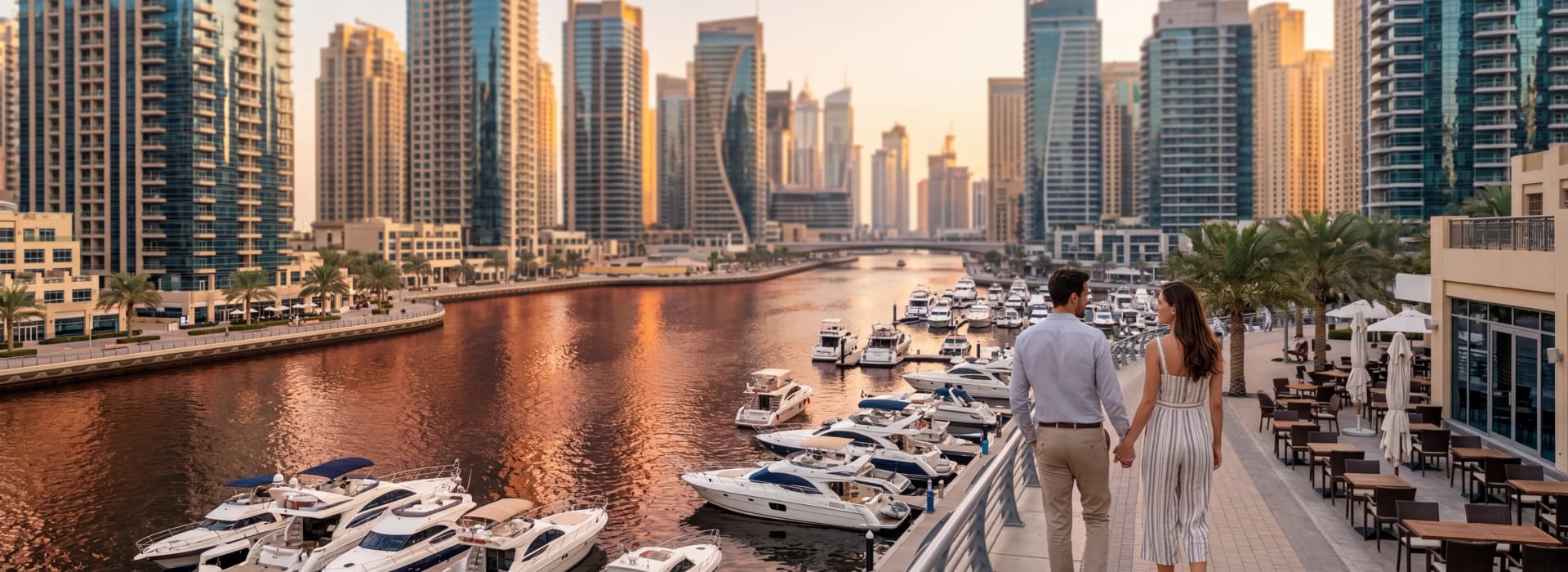
Dubai Marina is a purpose-built waterfront community developed by Emaar Properties along a 3.5-kilometre man-made canal in the heart of Dubai's New Dubai corridor. The district spans more than 200 residential towers and sits flanked by Jumeirah Beach Residence to the west and Jumeirah Lake Towers to the east. This is not a neighbourhood that evolved organically. Every tower, promenade, and amenity was planned within a single master design, which is why the experience of walking the Marina feels cohesive in a way that many other parts of Dubai simply do not.
What sets Dubai Marina apart is the density of lifestyle infrastructure within walking distance. The 7-kilometre Marina Walk connects residents to over 300 retail outlets, international restaurants, coffee shops, and fitness studios without requiring a car. The area is also home to XLine Dubai Marina, one of the world's longest urban zip lines, which has become an unofficial landmark for the neighbourhood.
The community has now been fully built out for more than a decade, meaning buyers are purchasing into established infrastructure rather than development promises. Building quality varies tower to tower, but the surrounding public realm, promenade, and amenity base are fully formed. That maturity is increasingly valued in Dubai's 2026 market, where newer districts still carry completion risk.
Who Lives in Dubai Marina and Why?
Dubai Marina attracts a specific type of resident. Young professionals working in Media City, Dubai Internet City, or JLT choose the Marina because the commute is ten to fifteen minutes on foot and evenings offer a social scene that suburban communities cannot replicate. Expat couples wanting walkable, high-energy urban living consistently rank the neighbourhood first across Bayut and Property Finder search data.
For NRI and international investors, the Marina delivers a different kind of appeal. It is a recognised global address. When a tenant from India, the UK, or Europe searches for a premium Dubai rental, Dubai Marina appears in most conversations. That brand recognition translates into consistent rental demand and low vacancy rates, which matters to landlords managing properties remotely. According to Property Finder data, Dubai Marina regularly features in the top three most searched areas in the UAE for both sales and rentals.
Short-term rental operators also concentrate here. Proximity to JBR Beach, Ain Dubai on Bluewaters Island, and the Marina Walk creates year-round tourism foot traffic. Well-furnished studios and one-bedrooms managed through licensed short-let platforms achieve occupancy rates supporting gross yields between 8.5 and 11 percent, according to GuestReady 2026 rental data.
The one demographic the Marina does not serve particularly well is families with school-age children. There are no major schools within the immediate community, meaning parents face daily commutes to institutions in Al Sufouh, Jumeirah, or beyond. Families who prioritise a car-free school run tend to look at Arabian Ranches, Mirdif, or Dubai Hills Estate instead.
Dubai Marina Property Prices and Rental Yields in 2026
Dubai Marina sits firmly in the premium tier of the Dubai residential market. According to DXB Analytics data based on verified Dubai Land Department transactions, the average price per square foot across the community stood at approximately AED 2,661 in early 2026. Engel and Volkers February 2026 data places the community average closer to AED 2,061 per square foot, reflecting the wide range between older inner-canal buildings and premium waterfront towers. Entry-level secondary market units in older towers start from around AED 1,400 per square foot, while prime Marina-facing towers comfortably exceed AED 3,000 per square foot.
For buyers in absolute terms, one-bedroom apartments in January 2026 range from AED 1.6 million to AED 3.6 million, with the spread driven by floor level, view orientation, and building quality. Two-bedroom units typically sit between AED 2.5 million and AED 5.5 million. The DLD recorded an 18 percent increase in transaction volumes across Dubai Marina during 2025, a figure that reflects sustained investor confidence rather than speculative momentum.
Rental performance remains strong. Studios let for AED 65,000 to AED 130,000 annually. One-bedroom apartments command AED 90,000 to AED 220,000 per year, and two-bedrooms typically achieve AED 140,000 to AED 350,000, according to D&B Properties 2026 data. Rents across the Marina increased approximately 8 to 10 percent year-on-year through 2025, supported by constrained supply and consistent demand from professional tenants. Gross rental yields for standard long-let apartments sit between 5.5 and 7.2 percent, with smaller units performing at the higher end of that range.
An important structural factor supporting these numbers is limited new supply. Unlike emerging communities such as Dubai South Area Guide or JVC, Dubai Marina is almost fully built out. Knight Frank's Q3 2025 market review confirmed the area remains a hotspot for mortgage-backed purchases, with financing volumes more than doubling over four years. That shift to mixed financing signals a broadening buyer base, which generally supports price stability.
Getting Around: Transport and Connectivity
Dubai Marina is one of the few residential communities in Dubai where car ownership is genuinely optional. The Red Line of the Dubai Metro serves the community through two stations: Sobha Realty Metro Station at the eastern edge and DMCC Metro Station further south. Both stations connect directly to the rest of the city, reaching Downtown Dubai and DIFC in under 25 minutes and Dubai International Airport in approximately 35 to 40 minutes.
The Dubai Tram adds a second tier of connectivity, running through 11 stations that loop through the Marina, JBR, and Al Sufouh before connecting back to the Red Line. For residents heading to Palm Jumeirah, the Tram provides a direct link to the Palm Monorail. RTA Water Taxis operate from the Marina's internal waterway and offer a scenic alternative for shorter journeys to the Dubai Harbour area.
For drivers, Sheikh Zayed Road runs immediately adjacent to the community, giving straightforward access to Downtown Dubai and the airports. The main practical challenge is internal congestion. On weekends and during the November to March peak season, streets inside the Marina back up, and parking near the Marina Walk fills quickly. Residents with flexible hours experience few friction points. Those commuting into DIFC or Business Bay at 8am should budget 30 to 40 minutes during peak traffic.
Common Questions Buyers Get Wrong About Dubai Marina
The most frequent misconception is that high prices mean high yields. In Dubai Marina, the relationship is more nuanced. Premium towers with views command the highest sale prices but often deliver yields of 5 to 6 percent because the capital cost is proportionally higher. Mid-tier buildings in the inner canal, priced from AED 1,400 per square foot, can actually outperform on gross yield because tenants pay for the postcode rather than the specific tower. Investors who focus entirely on trophy buildings sometimes leave yield on the table.
A second common assumption is that Dubai Marina competes directly with Downtown Dubai for the same buyer. It does not. Downtown attracts buyers who want proximity to DIFC and the Burj Khalifa address, and it skews toward cash-heavy, ultra-luxury purchasers. Dubai Marina attracts a broader mix of professional end-users, yield-focused investors, and short-let operators. The price points overlap in the mid-range, but the tenant profiles and lifestyle propositions are meaningfully different.
Finally, some buyers worry the Marina is oversupplied because Dubai broadly has significant new inventory entering the market through 2026 and 2027. That concern does not apply equally here. Most of the approximately 366,000 units projected for delivery by 2028 per Cavendish Maxwell data are concentrated in JVC, Dubai South, Business Bay, and Dubai Islands. Dubai Marina's built-out status means far less supply pressure than emerging communities, supporting both rental and capital values through this cycle.
Disclaimer: This article is for informational purposes only and does not constitute financial, investment, or legal advice. Dubai real estate market conditions can fluctuate; always consult with a qualified professional before making any investment decisions. Dubai Property Insight is not liable for any actions taken based on this content.
Related Questions
Dubai Marina remains one of Dubai's most reliable investment addresses in 2026, though it rewards a strategic approach rather than a passive one. The community offers brand recognition, consistent tenant demand, and limited future supply that emerging areas cannot replicate. DLD transaction data shows an 18 percent increase in Marina volumes during 2025. Long-let gross yields sit between 5.5 and 7.2 percent, and short-term rental operators in well-located towers achieve 8.5 to 11 percent gross per GuestReady 2026 data. The key variable is entry price. Buyers focusing on mid-tier buildings priced between AED 1,400 and AED 2,000 per square foot typically generate the most balanced return profiles combining capital preservation with rental income.
Property prices in Dubai Marina in early 2026 range widely depending on building age, floor level, and view. Entry-level units in older secondary-market towers start from around AED 1,400 per square foot. The community average sits between AED 2,061 and AED 2,661 per square foot according to Engel and Volkers and DXB Analytics data respectively. Premium waterfront towers with direct marina views exceed AED 3,000 per square foot. In absolute terms, one-bedroom apartments range from AED 1.6 million to AED 3.6 million and two-bedrooms from AED 2.5 million to AED 5.5 million, based on January 2026 transaction data from Dubai Land Department records. New-build units carry an estimated 15 percent premium over comparable secondary market properties, reflecting developer payment plan flexibility and modern specifications.
Rental costs in Dubai Marina reflect the premium that waterfront, transport-connected living commands. Studios let annually for AED 65,000 to AED 130,000, which D&B Properties notes is approximately 50 percent above the Dubai citywide studio average. One-bedroom apartments achieve AED 90,000 to AED 220,000 per year, with variation driven primarily by building quality, floor level, and whether the unit carries marina or sea views. Two-bedroom apartments command AED 140,000 to AED 350,000. Rents increased approximately 8 to 10 percent year-on-year across 2025 according to DLD rental data. View premiums are real: units with full marina-facing balconies typically achieve 15 to 25 percent more than equivalent units facing inward or toward Sheikh Zayed Road. Flexible multi-cheque payment arrangements are increasingly available from landlords, though single-cheque tenants retain negotiating leverage.
Dubai Marina suits certain family configurations well and others less so. Couples, young families with pre-school children, and households where at least one parent works locally will find the lifestyle offering genuinely compelling. The community is safe, walkable, and rich with amenities including gyms, swimming pools, cafes, and beach access within minutes. The significant limitation for families with school-age children is the absence of established schools within the community itself. Most parents drive children to schools in Al Sufouh, Umm Suqeim, or Jumeirah, adding a daily commute of 10 to 25 minutes each way. Families who place a high value on walkable school access typically find Dubai Hills Estate, Arabian Ranches, or Mirdif more practical. That said, numerous Dubai Marina residents successfully manage the school commute and consider the neighbourhood's lifestyle advantages a fair trade.
Dubai Marina and JBR share geography and complement each other. JBR is the beachfront strip immediately adjacent to the Marina, offering a lower-rise, tourist-heavy environment with direct beach access. Most Marina residents treat JBR as an extension of their neighbourhood rather than a competitor. Downtown Dubai serves a different buyer profile entirely. It attracts cash-heavy purchasers seeking proximity to DIFC, the Burj Khalifa address, and ultra-luxury product, with prices typically ranging from AED 2.2 million to AED 6 million for standard apartments. Dubai Marina overlaps with Downtown in the mid-range bracket but draws a broader mix of professional end-users and yield-focused investors. Short-term rental performance favours Dubai Marina over Downtown due to stronger tourism infrastructure, beach proximity, and year-round foot traffic from JBR and Bluewaters Island.
Yes. Dubai Marina is a fully designated freehold zone, meaning foreign nationals and expatriates can purchase and hold 100 percent ownership without a local partner. This applies equally to NRI buyers from India, European investors, and any other nationality. Ownership rights are registered directly with the Dubai Land Department. For buyers financing a purchase, UAE banks offer LTV ratios up to 80 percent for first-time buyers on properties below AED 5 million, subject to income eligibility. Property ownership does not automatically confer residency, though investors meeting the minimum threshold can apply for property-linked UAE residency visas through DLD and ICP procedures.